
PTFE Polytetrafluoroethylene Resin PTFE-770 Binder for Dry-Process Electrodes
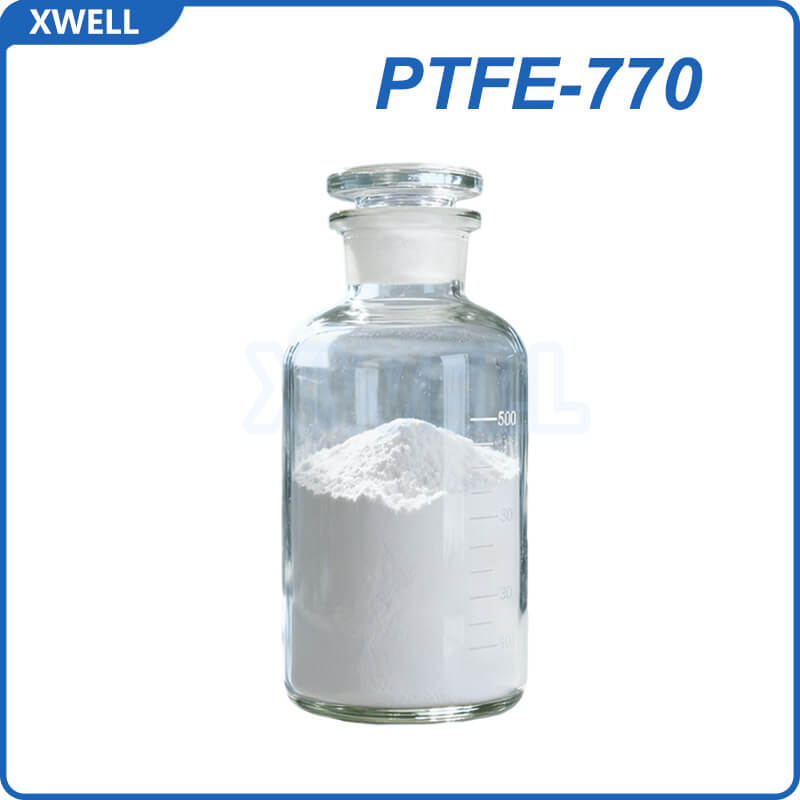
Model:PTFE-770
Molecular Weight: ~7.7 million
Characteristics:General-purpose Resin
Particle Size:~400μm
Bulk Density: 326 ~ 328°C
Specific Gravity:2.14 ~ 2.20
Tensile Strength:>30MPa
Elongation Rate:>300%
Compression Ratio:<500
MOQ: 250g
Leading time: 5-8 working days
PTFE Polytetrafluoroethylene Resin PTFE-770 Binder for Dry-Process Electrodes
1. Product Overview
Universal fluororesin, widely used in electronic and electrical products, packaging materials, pipelines, and more.
2. Key Features
High temperature resistance, chemical inertness, low friction coefficient
3. Technical Specifications
| Specification | Test Method | Unit | Test Value |
|---|---|---|---|
| Particle Size | ASTM D1457 | μm | ~400 |
| Bulk Density | ASTM D1457 | g/L | ~550 |
| Melting Point | ASTM D1457 | °C | 326 ~ 328 |
| Specific Gravity | ASTM D1457 | — | 2.14 ~ 2.20 |
| Tensile Strength | JIS K6891 | MPa | >30 |
| Elongation Rate | JIS K6891 | % | >300 |
| Compression Ratio | — | — | <500 |
| Molecular Weight | ~7.7 million | ||
| Characteristics | General-purpose Resin | ||
| Application | Medium/large-diameter wires, medium/large-diameter pipes, fibers, raw material tape, wrapping film, etc. | ||
Note: 1. Compression Ratio: The ratio of the cross-sectional area of the resin in the extrusion cylinder (S1) to the cross-sectional area of the resin at the die opening (S2), i.e., R.R = S1/S2.
4. Applications
- Dry-process/wet-process battery electrodes (binder), electronic components, chemical pipelines, non-stick coatings
5. Usage Instructions
- Direct Use or Dilution: Can be applied as-is or diluted with deionized water.
- Mixing Process: Add to powder in reactor—high-speed stirring won’t break emulsion.
- Slurry Control: Adjust water content to achieve desired viscosity.
- Final Steps: Sieve, degas, and discharge slurry after dispersion.
- Storage: Store at low temperature; optimal temperature: 19°C